Two-storey extension applications have almost halved since 2021
Applications to build two-storey extensions have fallen by almost half in four years.
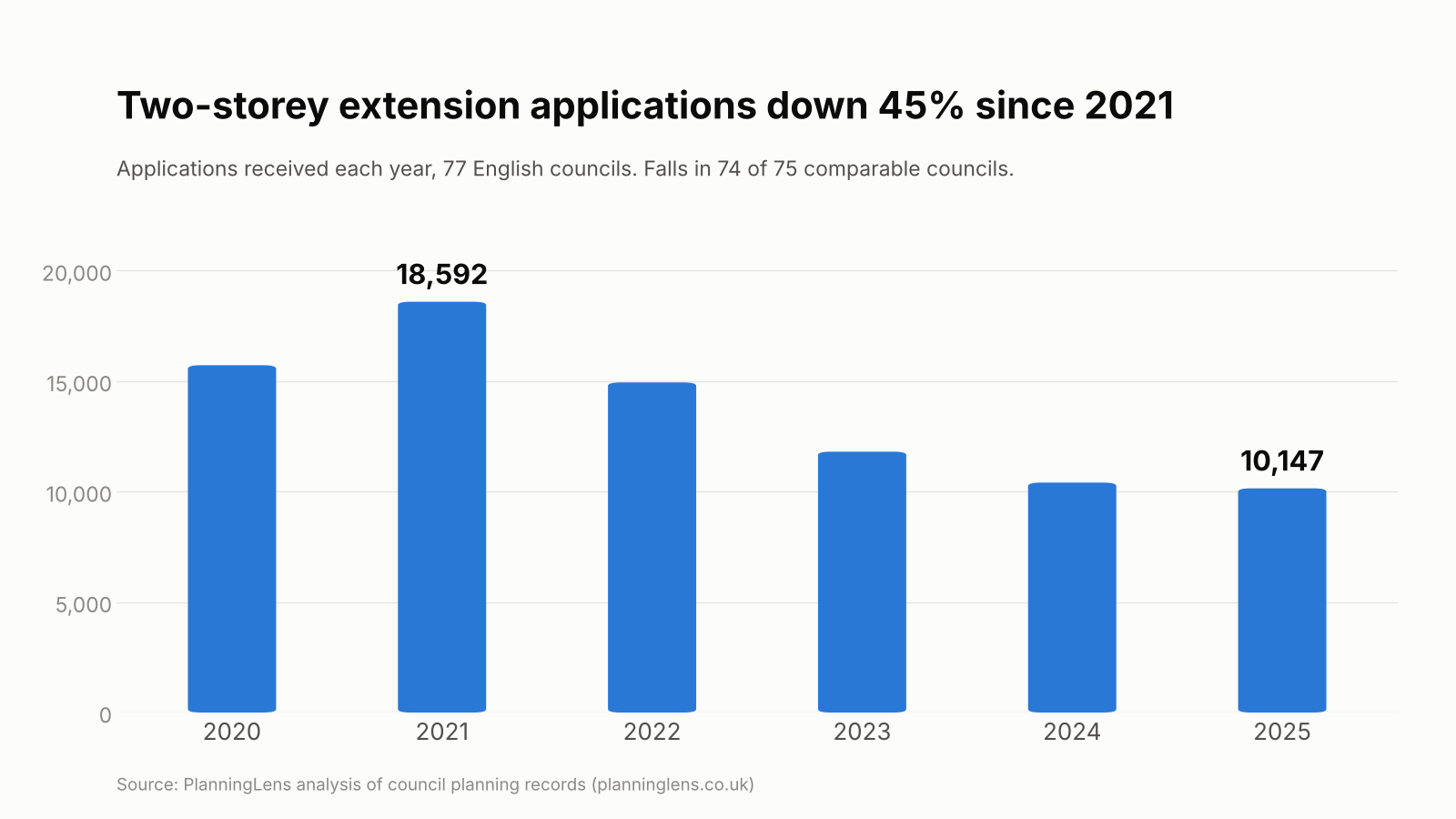
In the 77 English councils analysed by PlanningLens, 18,592 applications for two-storey extensions were received in 2021. In 2025 the figure was 10,147, a fall of 45%.
The decline was recorded in 74 of the 75 councils with enough applications to compare. In the typical council, applications fell by 47%.
Two-storey extension applications received each year, 77 English councils. Source: PlanningLens analysis of council planning records.
The fall reaches almost everywhere
A steep fall in a handful of large councils can drag down a national total. That is not what happened here.
Of the 75 councils that received at least 20 two-storey extension applications in both 2021 and 2025, 74 received fewer in 2025. Lowering the bar to 10 applications brings in one more council, and the result holds: 75 of 76 fell.
The median council, the one in the middle when all are ranked, recorded a fall of 47%, slightly steeper than the total. Taking out the five councils with the most applications, led by Leeds and Barnet, does not weaken the result. Nor does taking out any single council.
The steepest drop came straight after 2021. Applications fell to 14,940 in 2022 and 11,807 in 2023. The decline has since slowed: 2025 was 2.5% below 2024.
Not just the end of a renovation boom
2021 was the busiest year in these records. A fall from a peak is less surprising than a fall from normal levels, so the obvious question is whether applications have simply returned to where they were before the pandemic.
They have not. Forty-eight of the councils have records reaching back to 2019. In those councils, two-storey extension applications in 2025 were 36% below their 2019 level, and lower than in 2019 in 47 of the 48.
Applications were almost level in 2019 and 2020, at 8,642 and 8,471. They jumped to 10,070 in 2021. Every year since has been lower, and by 2023 they had dropped below the pre-pandemic level. In 2025 there were 5,538.
The records show the scale and timing of the fall. They do not show why it happened.
London fell less
London recorded the smallest fall. Two-storey extension applications in the 15 comparable boroughs fell 35% between 2021 and 2025, against 49% in the rest of England.
Outside London the fall was close to universal. All 60 comparable councils outside the capital received fewer applications in 2025 than in 2021. Even the councils that held up best fell by about a third: Dartford, Kirklees and Elmbridge each recorded falls of 34%.
The size of the fall was similar across the rest of England. Councils in the South and East fell 47%, in the North 50% and in the Midlands 55%.
In London, 14 of the 15 comparable boroughs fell. A wider check covering 30 London boroughs gives a similar fall, of 37%.
Other home alterations
Two-storey extensions fell furthest, but they did not fall alone. Across the same councils and years, applications for single-storey extensions fell 43% and loft conversions 40%. Porches fell 30% and garage conversions 28%.
Garden buildings, such as summerhouses and outbuildings, and annexes each fell by about a fifth.
The larger alterations to homes fell much more sharply than garden buildings and annexes. Many smaller projects, including some garden buildings, need no application, so these counts show the direction of each category rather than a full record of the work.
Where the falls were sharpest
The steepest falls, among councils that received at least 100 two-storey extension applications in 2021, were spread across England. In Newark and Sherwood, applications fell from 178 to 57, down 68%. The Isle of Wight went from 127 to 44, Gateshead from 171 to 62 and Doncaster from 304 to 116.
These are the extremes. The typical council fell by 47%.
| Council | 2021 | 2025 | Change |
|---|---|---|---|
| Newark and Sherwood | 178 | 57 | -68% |
| Isle of Wight | 127 | 44 | -65% |
| Gateshead | 171 | 62 | -64% |
| Doncaster | 304 | 116 | -62% |
| Thanet | 150 | 59 | -61% |
| Sunderland | 165 | 65 | -61% |
| New Forest National Park | 121 | 48 | -60% |
| Rushcliffe | 320 | 128 | -60% |
| St Helens | 174 | 70 | -60% |
| Calderdale | 245 | 101 | -59% |
Every council's figures are in the download below.
Leeds recorded the largest fall in numbers. It received 1,152 two-storey extension applications in 2021 and 505 in 2025, 647 fewer.
What the figures show
These are planning applications, not completed extensions. An approved application may never be built, and some smaller extensions can go ahead under permitted development without an application at all. Planning applications therefore provide a measure of how many people sought permission for this kind of work.
The data shows how many applications were made, and where. It does not establish why fewer were made.
Official context
Official statistics also show a substantial decline in householder planning activity nationally. The government's planning statistics record 151,900 decisions on householder applications in England in the year to March 2026, down from 210,000 in the year to March 2023, according to the earlier release. Those figures count decisions rather than applications, use financial years and cover every council, so they are not directly comparable with this analysis.
The retreat is broad. Applications for two-storey extensions have fallen by almost half since 2021, they now sit well below their level before the pandemic, and the fall appears in nearly every comparable council in the sample, inside London and outside it.
Download the data
Council figures, 2021 and 2025 (CSV) · Chart (PNG)
How we did it
Method. The method was fixed on 5 September 2026 and rerun unchanged on 3 October 2026.
Councils. The analysis uses a fixed panel of 77 English councils (16 London boroughs and 61 elsewhere) whose planning records held at least 500 readable application descriptions in every year from 2020 to 2025, with no year more than doubling or halving, and with records running into 2026. A council needs at least 20 two-storey extension applications in both 2021 and 2025 to count as comparable; 75 do. The panel is not a random sample of England, and the figures are not a national estimate.
What counts. An application counts as a two-storey extension when its description proposes a two-storey (or double-storey) extension or a first-floor extension. Mentions of an extension being demolished or removed do not count, and nor do follow-on paperwork (discharge of conditions, amendments, variations and certificates for existing work), new-build schemes or commercial premises. Each application is counted once, by the year it was received.
Checks. The result holds under every test we ran. Two-storey applications, 2021 to 2025:
| Main result, 77 councils | -45.4% |
| Literal "two-storey" wording only (first-floor wording excluded) | -46.9% |
| Dated by received or validated date only | -45.3% |
| Typical (median) council | -47.3% |
| Five largest councils removed | -46.6% |
| Councils with known date faults removed (Rutland, Barking and Dagenham, Warrington) | -45.7% |
| Any single council removed (range) | -44.7% to -46.4% |
| Wider panel of 91 councils including all 30 London boroughs with records | -44.1% |
| 2019 to 2025, 48 councils with records back to 2019 | -35.9% |
| Original test: 2020 and 2021 combined against 2024 and 2025 combined | -40.1% |
Government planning statistics count decisions by financial year across all councils, so they are context for this analysis, not a like-for-like comparison.
Exceptions. Camden recorded the same number of applications in both years (75), while its recorded applications of all kinds rose 2.6 times, so its trend reflects how its records are captured. The City of London recorded no two-storey extension applications. Greater Cambridge records were left out while a separate data repair was under way; Cambridge was not part of the panel.
Questions and answers
How much have two-storey extension applications fallen?
By 45% between 2021 and 2025 across 77 English councils, from 18,592 applications to 10,147.
Is the fall widespread?
Yes. Applications fell in 74 of the 75 councils with enough applications to compare, and in every comparable council outside London.
Is this just the end of the lockdown boom?
No. In the 48 councils with records back to 2019, applications in 2025 were 36% below their 2019 level, and lower in 47 of those 48 councils.
Does the data say why?
No. It shows how many people applied for permission. It does not show their reasons.